Home

Join

Main Menu


blog advertising is good for you

Links

Will the Real Indiana Legislature Please Stand Up

by Abdul Hakim-Shabazz

As someone who describes his personal politics as fiscally conservative and socially libertarian, I can honestly say this past session of the Indiana General Assembly made me a very happy camper and also managed to annoy the hell out of me at the same time.  For every bill that gave Hoosiers more freedom or put more money back in their pockets there seemed to be some silly idea that managed to get traction, but should have never seen the light of day.

Let’s start with the money.

If you are a big fan of economic freedom and lower taxes, then this was the session for you.  Lawmakers passed a bill that phases out the inheritance tax over the next ten years.  So if you work hard and accumulate wealth you can actually leave it to your children and not to the government.  If you like your money a little sooner, you’ll be eligible for a taxpayers’ refund when the state surplus gets 12.5% above revenue.  And the nice thing about that is that it doesn’t matter what your income is, you pay taxes, you get your money back.  Please point to me a state government north of the Mason-Dixon line and east of the Mississippi River that is not only cutting taxes, but giving back the taxpayers their hard-earned money.  And let’s not forget the 800-pound legislative gorilla in the room, right to work.  You remember the bill that says you can’t be compelled to pay union fees as a condition of your employment.  Yeah, that one.  The same bill which the unions filed a lawsuit to stop.  They even asked for a temporary restraining order to stop the legislation from going into effect and impeding current contracts.  They later had to withdraw their request because one of them actually read the bill and found out the law only impacts those contracts created or modified after March 14.  Workers should be free to choose whether they want to be part of a union.

Lawmakers also made my day with their work on education: more money for full-day kindergarten, multiple count days for school enrollment so money more accurately can follow the child, and a cap on college credit hours (120) for graduation, unless colleges have a good reason to do otherwise.  Throw in a reasonable smoking ban and some anti-nepotism at the local government level and you have the making of a pretty cool legislative body.

Unfortunately, for every moment of universal joy, there is also some universal pain.  There were some things lawmakers did that make the social libertarian in me cringe.  For example, does anybody really think it’s a good idea to mandate creationism be taught in school?  It’s one thing if we were talking multiple theories from different world perspectives, but we all know what was really going on here; Adam, Eve, Cain, Able and the snake.  My kingdom for the giant spaghetti monster theory to be taught in school.  And if that wasn’t enough, we got into a silly debate over whether an organization that supports gay youth should get a license plate.  Really?  How many organizations get license plates in this state?  It’s stuff like this that makes a place look really  backwards and lands you in federal court staring down the barrel of a first amendment lawsuit.  However the granddaddy of all bonehead moves out of the Indiana General Assembly had to be Representative Bob Morris’ comments that the Girl Scouts were a pro-abortion/pro-lesbian organization.  The only thing worse than his comments was the fact that would not exercise the better part of valor but kept talking about it.   The irony of it all was that Bob probably did more to sell Girl Scout cookies than he could have possibly imagined.  I even bought extra boxes from my nieces just to show my frustration.

A couple other bills that sort of fell in the middle of good lawmakers/bad lawmakers were mass transit and the right to resist illegal police entry.  It would have been good had lawmakers voted to allow Marion and Hamilton county residents vote on whether they want a tax increase to pay for mass transit.  Such is the curse of an election year.  In addition, thanks to Senate Bill and Hoosiers being given the right to resist law enforcement due to an illegal entry, I worry about picking up a newspaper and reading about a dead police officer who was shot serving a warrant because the homeowner “thought” he or she was entering the house illegally.  I can respect the Castle Doctrine, but the last thing I want is open season on law enforcement. Unfortunately, we usually don’t know if an entry was illegal until after we get to court.

Overall, I think lawmakers did well this past session.  Legislation that gave Hoosiers more economic freedom and put money in their pockets got to see the light of day while some pretty bad ideas went by the wayside.  I guess, if the real General Assembly had to stand up, it was the one that passed the former and let the latter die on the vine.
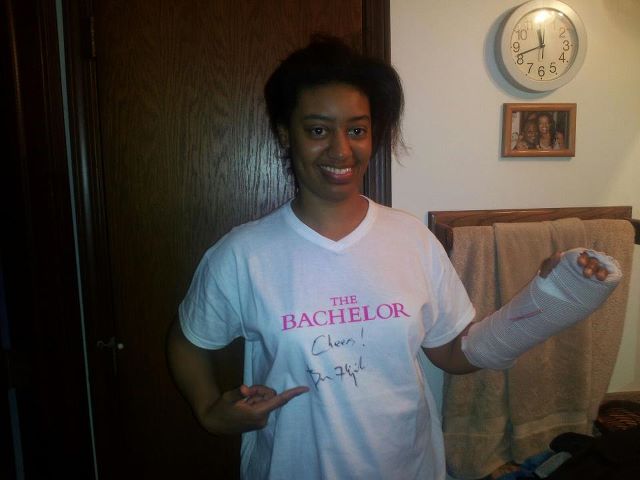

 

Slightly Broken, But Always Beautiful

by Abdul Hakim-Shabazz

If you follow me on Facebook or Twitter, you know my wife was in a car accident this past Thursday.  She is recovering quite nicely and I thought I’d upload a quick photo of her.  The car was totaled, but she managed to walk away with a broken wrist and few bruises.  We are extremely fortunate that things turned out the way they did.  Had she been hit by the driver a few seconds earlier or later we would be having an entirely different conversation right now.  Cars can be replaced, amazing wives can’t.

Get the White Out

by Abdul Hakim-Shabazz

I originally wrote this column back in June of 2011.  Since Dr. Eugene White is looking for a new job, I figured the least I could do is let any future employer know what they are getting. 

******

Picture this.  A CEO of a company who makes nearly $250,000 in salary and benefits.  His company loses about 1,000 customers annually.  It has a product completion rate of less than 50%.  Facilities are struggling to fill space.  A majority of his board of directors are mindless automatons that rubber stamp his every decision.  Instead of taking responsibility for his actions and failures, he would prefer to blame the competition.  And when the government has warned him time and again that if his company doesn’t get its act together, it will step in and take over  instead of addressing the problem, tries to cut a last minute deal.   Hard to imagine?  Not really when you know that CEO is Dr. Eugene White, commander-in-chief of the personification of the area of Murphy’s law known as the Indianapolis Public Schools.

Since I am incapable of harboring any white, liberal guilt, I have no problem in criticizing Dr. White and IPS.  Dr. White, along with his enablers, is the problem and is the reason why the State of Indiana is in the process of taking over several IPS schools. For the past five years, Broad Ripple,  Arlington Community,   Manual, Northwest, Howe and George Washington High Schools, along with Donna Middle School, have been on academic probation for being failing schools.  Hearings started this week on state intervention and now everyone is freaking out over the possibility that the Department of Education will step in and do the job that should have been done back in 2005.

Locals are trying to organize and tell what they believe is good news about these failing schools and offer their alternatives to a state takeover.    Some Indiana House Democrats are trying to put out a mailer accusing Republicans of wanting to take over inner-city schools (and not include the fact the schools were failing).  Even Democratic Mayoral candidate Melina Kennedy is wading into the topic offering vague, generic, proposals to improve education.   They are about as exciting as mayonnaise on white bread, but I’ll give her credit for pretending to care.

White has been trying to negotiate with the State to avoid a takeover of the failing schools.  Just this past Monday, he begged officials that he should be allowed to operate his failing schools under the new changes in state law regarding collective bargaining and teacher evaluations. This is the same person, who according to the same state officials I spoke with, never took advantage of current state law to make changes in his low-performing schools.  If anything he acknowledged that up to 60% of the teachers in some schools were “pedestrian”.  And while White can blame collective bargaining rules on not being able to eliminate bad teachers, there’s no excuse for taking administrators from one failing school and sending them to another failing school.  White has done the equivalent of putting the Captain of the Titanic in command of the Exxon Valdez.

This is just a series in a long line of events that has brought IPS to this point.  White has vowed to break state law and deny enrollment to students who leave the district for charter schools and try to return at a later date.  He has refused to give board members detailed copies of the budget; I had to file an open records request to get one.  And while he is part of a group that supports mayoral control of IPS, I argue it is not because he cares about accountability it is because he thinks it the best way he can save his skin and not have to deal with any real accountability.

So what is the moral of this story?  Over the next few weeks, as these hearings over the possible state takeover of several IPS schools get underway, don’t believe a word Eugene White tells you.  He, his administration, and the board members who rubber stamp his every move are the epitome of the decline of modern public education.  Behind closed doors they blame IPS’ problems  on the Governor and Superintendent of Public Instruction.  IPS’ own attorneys have told them what’s coming, but the District doesn’t want to listen.   If they had been doing their jobs, we wouldn’t be here right now.   My only regret is that the state doesn’t takeover the entire school district and send White and his minions to the unemployment line where they belong.


As Good As It Gets

by Abdul Hakim-Shabazz

The Indiana House and Senate today will vote on a smoking ban that advocates don’t like, can’t stand and just find plain morally offensive.   But it will also be about as good as a ban that they will ever get.

The highlights of smoking ban compromise are as follows…

  • Smoking is allowed in bars and taverns as long as no one under 21 is allowed.
  • Not-for-profits and fraternal clubs could have smoking and allow minors as long as the minors are not allowed in smoking areas and the clubs vote every two years on whether to stay smoking.
  • Smoking is banned in mental health, nursing facilities and charity gaming events.
  • Local governments could pass tougher restrictions and not be preempted by state law.

The American Cancer Society opposes what they call a weakened ban.   However, the Indiana Chamber, which supports a smoking ban, says a total ban is unrealistic and lawmakers should pass the proposal.   Brad Klopfenstein of the Tavern League of Indiana said the compromise is something his members can live with.

So if everyone else is on board,  I don’t see what the Cancer Society’s problem is.  75% of something will always be better than 100% of nothing.  The problem with smoking ban zealots, regardless of which end of Market Street they are on, they just can’t accept the reality of the situation.    In fact, if they were smart, they should reach out to the bar and tavern owners and work with them and convince them to go smoke free and if not, at least identify which places are smoking and non-smoking and create a job board for servers and bartenders so they can be informed about which places are smoking and they can make better decisions.

But if you can’t see the political forest for the trees, why are you in politics?

The Lugar Lawsuit

by Abdul Hakim-Shabazz

Opponents of U.S. Senator Richard Lugar are going to court to attempt to do what they couldn’t at the Indiana Election Commission, get him off the ballot.

Indianapolis attorney Eric Bohnet has filed suit in Marion County Court asking the Court to overturn the Election Commission’s ruling that was Lugar was qualified to be on the ballot.   The Election Commission voted unanimously to keep the Senator on the ballot.  In addition, the Lugar campaign has presented the opinions of three Indiana Attorneys General saying he is not in violation of any law.

The plaintiffs argue that Lugar isn’t qualified to be on the ballot because he is not an inhabitant of Indiana because he keeps a home in Virginia.  The lawsuit also goes on to state that by allowing Lugar on the ballot, the Election Commission violated Article 1, Section 3, clause 3 of the Constitution.

No person shall be a Senator who shall not have attained to the age of thirty years, and been nine years a citizen of the United States and who shall not, when elected, be an inhabitant of that state for which he shall be chosen.


Citing the case of Jones v. Texas (2000), Bohnet says an inhabitant is defined as someone who has a physical presence in the state and it intends to be his place of habitation.

However the law also says that individual must be an inhabitant of that state when elected, so even if a Court were to find that Lugar was not an inhabitant when he filed, that situation could easily be corrected.

No court date has been set.  A copy of the complaint can be found here.  It is saved in Slideshare, which may be incompatible with some Apple products.


First 5th CD Candidate Hits Airwaves

by Abdul Hakim-Shabazz


Susan Brooks is the first 5th District candidate to hit the airwaves with a television ad.  The spot began airing Monday and her campaign says it will reach voters in all eight counties in the 5th District.  In her ad Brooks says she’s running against “good guys who are career politicians” and she calls her real opponents “the big spenders in Washington, D.C.”

The ad will run on select cable stations, including Fox News for the next three weeks.  The campaign plans to buy more airtime as the primary gets closer.


Study Shows Choice Does Not Financially Harm School Districts

by Abdul Hakim-Shabazz

*In the interest of full disclosure,  I do  some occasional work with the Friedman Foundation on school choice issues.  With that said, I have always been a big advocate of choice, vouchers and education reform, so I am not reprinting anything here that is inconsistent with my core values on education.

A new study by the Friedman Foundation for Education Choice has revealed that  school choice does not  financially harm traditional public education.

The report released today entitled,  “The Fiscal Effects of School Choice Programs on Public School Districts,”  found that 36 percent of public school expenses are “fixed” costs while 64 percent are “variable” costs over a one year period.  “Fixed” costs are related to buildings and other capital investments. “Variable” costs cover instruction, curriculum and other related costs.

Ben Scafidi, author of the report, and senior fellow with the  Friedman Foundation says there is no fiscal harm when public schools lose students to a school that better fits their needs.  If anything, Scafidi says, the schools have more money when students leave because they have fewer to educate and they get to keep some of the funds they were allotted.

The report also showed that if school systems retain 36 percent of the funds to educate each student,  after the child has left the system, then they will be able to fund the “fixed” costs that remain with school systems.

The report estimates that the average spending per child across the United States was $12,450 during the 2008-09 academic year. Fixed costs account for about $4,482 per student on average.

Robert Enlow, President and CEO of the Friedman Foundation noted, if districts have school choice programs and lose a few hundred children, they really are benefiting financially because they keep many of the dollars spent on each child. In no other business in America do you still get paid for not having a customer to serve, he said

Scafidi also added that “variable” costs which cover instruction and learning can easily be reduced when a student departs because there are fewer students to teach – especially from one year to the next.

There currently are 34 school choice programs in 19 states and other jurisdictions including voucher, tax credit and education savings account programs to offer parents the opportunity to utilize their own tax dollars to transfer to the school of their choice.

To read the full report, visit http://EdChoice.org/ScafidiFiscal2012

The Most Dangerous Jobs in America

by Abdul Hakim-Shabazz

I recently did an Internet search of the most dangerous jobs in America.  Here’s what I came back with according to the Bureau of labor Statistics.

  1. Commercial fisherman.
  2. Logging workers.
  3. Aircraft pilots and flight engineers.
  4. Farmers and ranchers.
  5. Coal mining.
  6. Roofers.
  7. Refuse and recyclable material collectors.
  8. Truck Drivers.
  9. Police and Sheriff patrol officers.
  10. Electrical power-line repairers and installers.
  11. Construction Laborers.
  12. Taxi drivers and chauffeurs.
  13. Grounds maintenance workers.
  14. Athletes, coaches and umpires.
  15. Operating engineers and construction equipment operators.

Nowhere on the list were bartenders or servers who worked in smoking environments.  I’m just saying.


The Last Seven Days of Session

by Abdul Hakim-Shabazz

Indiana House Speaker Brian Bosma admits that while the Indiana General Assembly  has had to deal with some “side issues” he tells the Statehouse press corps he is generally pleased with what lawmakers have done and thinks they can workout their remaining issues like the smoking ban and a Hoosier’s right to resist an unlawful police entry into their homes.

I’ve taken some of the highlights of the Speaker’s comments Thursday and embedded them below.

Leon Tailored Interview: Brian Bosma Part 1 (Run Time – 5 minutes)

  • Bosma provides a quick summary of what lawmakers will do next week.
  • Bosma says a partial smoking ban is better than no smoking ban.

Leon Tailored Interview: Brian Bosma Part 2 (Run Time – 10 minutes)

  • Bosma outlines his important priorities, including those which didn’t make it out of both chambers.
  • Bosma addresses his leadership role in keeping the caucus on track and avoiding “side issues”.

Leon Tailored Interview: Brian Bosma Part 3 (Run Time – 6 minutes)

  • Bosma discusses the retirement of 19 House members and what that will mean for the Chamber’s institutional memory.
  • Bosma talks about the upcoming election and the impact campaigns have had on the demeanor of the body and relationships within the Chamber.

Lawmakers will return on Monday. The are scheduled to sine die on March 9.


More Lugar v. Mourdock

by Abdul Hakim-Shabazz

U.S. Senator Richard Lugar goes on the offensive against primary challenger State Treasurer Richard Mourdock.  In a new television ad Lugar attacks Mourdock’s  attendance record at state boards and commissions on which he serves.  The Mourdock campaign called the ad misleading and a smear tactic .